
NLA Insights
1 July 2026
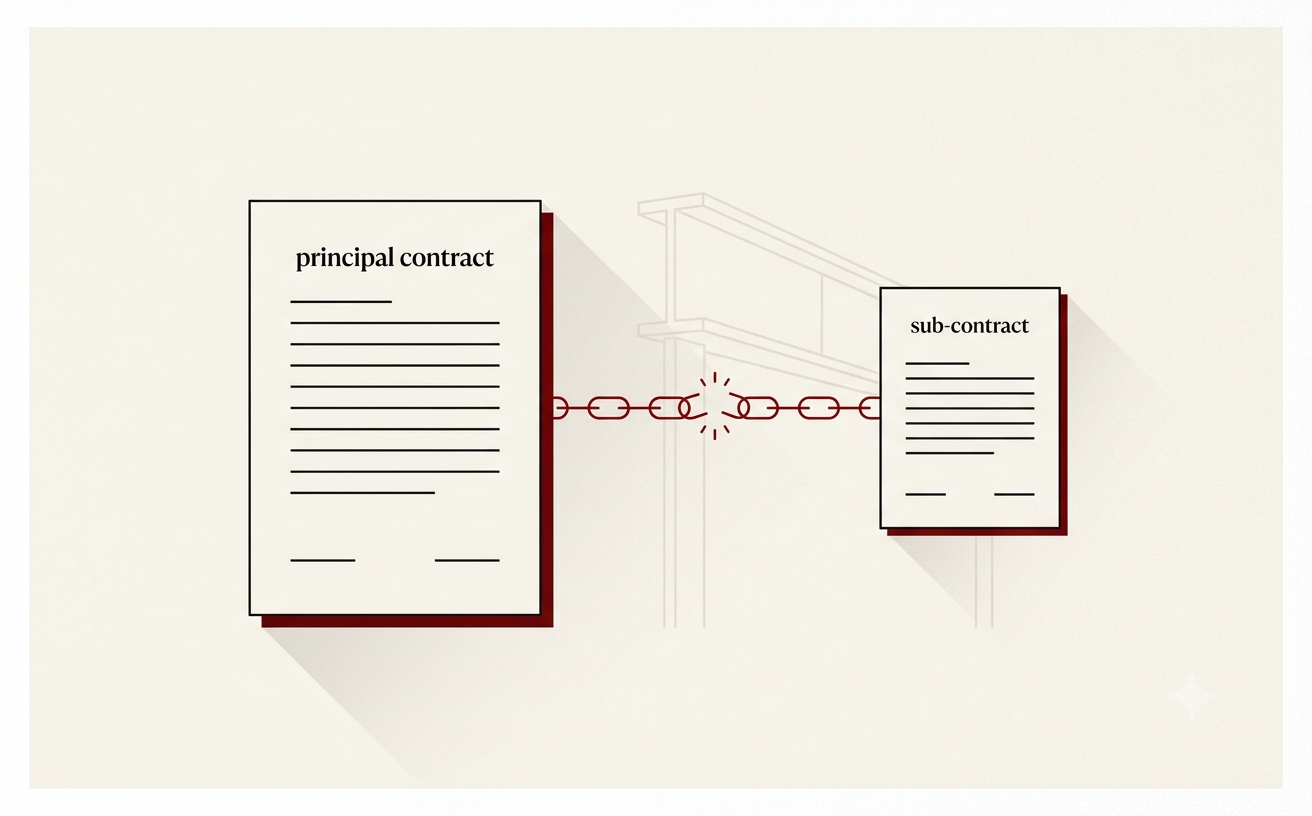
The Gauhati High Court, in M/s Yumiko Global Infra Tech Pvt. Ltd. v. M/s PRL-Gepong (JV), decided an important question concerning the incorporation of arbitration clauses from a principal contract into a sub-contract. The judgment examines the circumstances under which an arbitration clause contained in a main agreement can be relied upon by parties to a subsequent agreement and reiterates the principle that arbitration is founded on consent and cannot be imposed in the absence of a clear arbitration agreement.
The petitioner, Yumiko Global Infra Tech Private Limited, filed an application under Section 11(6) of the Arbitration and Conciliation Act, 1996 seeking appointment of an arbitrator for adjudication of disputes arising out of a sub-contract executed with the respondent, PRL-Gepong (JV). The petitioner contended that disputes had arisen between the parties and that the agreement contemplated resolution through arbitration.
The controversy arose because the sub-contract itself contained a dispute resolution clause providing for mutual discussions and, if unsuccessful, further meetings under the aegis of two named individuals. The clause did not expressly provide for arbitration. However, the definition clause of the sub-contract stated that the principal contract dated 31 March 2017 would form part and parcel of the agreement and that, wherever not mentioned, the provisions of the principal contract would apply.
The petitioner initially relied upon Clause 5 of the sub-contract as the basis for seeking appointment of an arbitrator, proceeding on the understanding that the said clause contemplated resolution of disputes through arbitration. However, after the respondent objected and contended that Clause 5 did not contain any arbitration agreement, the petitioner sought to rely upon Clause 29 of the principal contract, which contained an arbitration clause. The petitioner argued that since the principal contract had been incorporated into the sub-contract, the arbitration clause in Clause 29 also stood incorporated.
The respondent opposed the application, contending that the sub-contract contained its own dispute resolution mechanism and did not contemplate arbitration. According to the respondent, the petitioner’s reliance on Clause 29 of the principal contract was an afterthought, as the original basis of the petition was Clause 5 of the sub-contract.
The principal issue before the Court was whether the arbitration clause contained in the principal contract could be treated as incorporated into the sub-contract so as to constitute a valid arbitration agreement between the parties.
A connected issue was whether Clause 5 of the sub-contract itself could be construed as an arbitration agreement or as indicating an intention of the parties to submit disputes to arbitration.
The petitioner submitted that the definition of “sub-contract” expressly made the principal contract part and parcel of the agreement. Since the principal contract contained an arbitration clause, disputes between the parties were required to be referred to arbitration. Reliance was placed upon the Supreme Court decision in Hirani Developers v. Nehru Nagar Samruddhi CHS Ltd., where arbitration provisions contained in connected documents were recognised and enforced.
On the other hand, the respondent argued that arbitration is a consensual mechanism and cannot be inferred merely because another document contains an arbitration clause. It was contended that Clause 5 of the sub-contract specifically prescribed a method of dispute resolution through mutual discussions and meetings involving named individuals. Since the parties consciously provided a dispute resolution mechanism without arbitration, Clause 29 of the principal contract could not be imported into the sub-contract.
The respondent further submitted that the petitioner had changed its stand. The petition was initially founded on Clause 5 of the sub-contract, and it was only after the respondent filed its objection that the petitioner sought to fall back on Clause 29 of the principal agreement. Reliance was placed on M.R. Engineers & Contractors Pvt. Ltd. v. Som Datt Builders Ltd., NBCC (India) Ltd. v. Zillion Infraprojects Pvt. Ltd., Elite Engineering & Construction v. Techtrans Construction India Pvt. Ltd., and Mahanadi Coalfields Ltd. v. IVRCL AMR Joint Venture.
The High Court dismissed the petition and held that no arbitration agreement existed between the parties.
The Court observed that although the principal contract was stated to form part of the sub-contract, the incorporation was qualified by the expression “wherever not mentioned”. Since the sub-contract itself contained a specific clause dealing with dispute resolution, the field was already occupied by Clause 5 and there was no scope for importing Clause 29 of the principal contract.
The Court emphasised that arbitration is a special mode of dispute resolution that must be expressly agreed upon by the parties. The absence of a clear stipulation providing for arbitration cannot permit a party to compel arbitration merely by implication. Clause 5 contemplated only mutual discussions and intervention of named persons; it did not contain any indication that disputes would be adjudicated by a private tribunal whose decision would bind the parties. Therefore, it could not be characterised as an arbitration agreement.
The Court further noted that the petitioner had initially relied upon Clause 5 as the basis for arbitration and shifted its stand only after objections were raised by the respondent. This conduct reinforced the conclusion that the sub-contract itself did not contain any arbitration clause.
The Court relied heavily on the principles laid down by the Supreme Court in M.R. Engineers & Contractors Pvt. Ltd. v. Som Datt Builders Ltd., which held that an arbitration clause contained in another document becomes part of a contract only when there is a clear intention to incorporate the arbitration agreement and a specific reference indicating such incorporation. A general reference to another contract is ordinarily insufficient. The principles laid down in M.R. Engineers have subsequently been reiterated and affirmed in the cases of M/s. Elite Engineering and Construction (Hyd.) Private Limited, represented by its Managing Director v. M/s. Techtrans Construction India Private Limited, represented by its Managing Director, reported in (2018) 4 SCC 281.
The Court also referred to Mahanadi Coalfields Ltd. v. IVRCL AMR Joint Venture, wherein the Supreme Court reiterated that an arbitration agreement must disclose a clear and binding obligation to submit disputes to arbitration. Clauses merely contemplating discussions, negotiations, or future agreement to arbitrate do not amount to arbitration agreements.
Applying these principles, the High Court concluded that the requirements for incorporation of an arbitration clause had not been satisfied in the present case.
The judgment reinforces two important principles of Indian arbitration law.
First, arbitration remains a matter of consent. Courts cannot compel parties to arbitrate unless there exists a clear and enforceable arbitration agreement. Mere references to another document containing an arbitration clause will not suffice unless the contractual language demonstrates a clear intention to incorporate that clause.
Secondly, where a contract itself contains a specific dispute resolution mechanism, courts are unlikely to import an arbitration clause from another document. The presence of an independent dispute resolution clause indicates the parties’ intention regarding how disputes are to be resolved and may exclude incorporation of arbitration provisions contained elsewhere.
The Gauhati High Court’s decision serves as a reminder that incorporation of arbitration clauses by reference is subject to strict scrutiny. Parties drafting sub-contracts and ancillary agreements must expressly provide for arbitration if that is their intention. A general incorporation clause or reference to a principal contract may not be sufficient, particularly where the sub-contract contains its own dispute resolution mechanism.
Consequently, the Court held that Clause 29 of the principal contract could not be imported into the sub-contract and dismissed the application for appointment of an arbitrator under Section 11(6) of the Arbitration and Conciliation Act, 1996. The petition was ultimately dismissed without prejudice to the petitioner’s right to contest the pending money suit or to seek recourse to any other remedy available in law.
© Nirka Law Advisory. All rights reserved. For queries, connect with us.